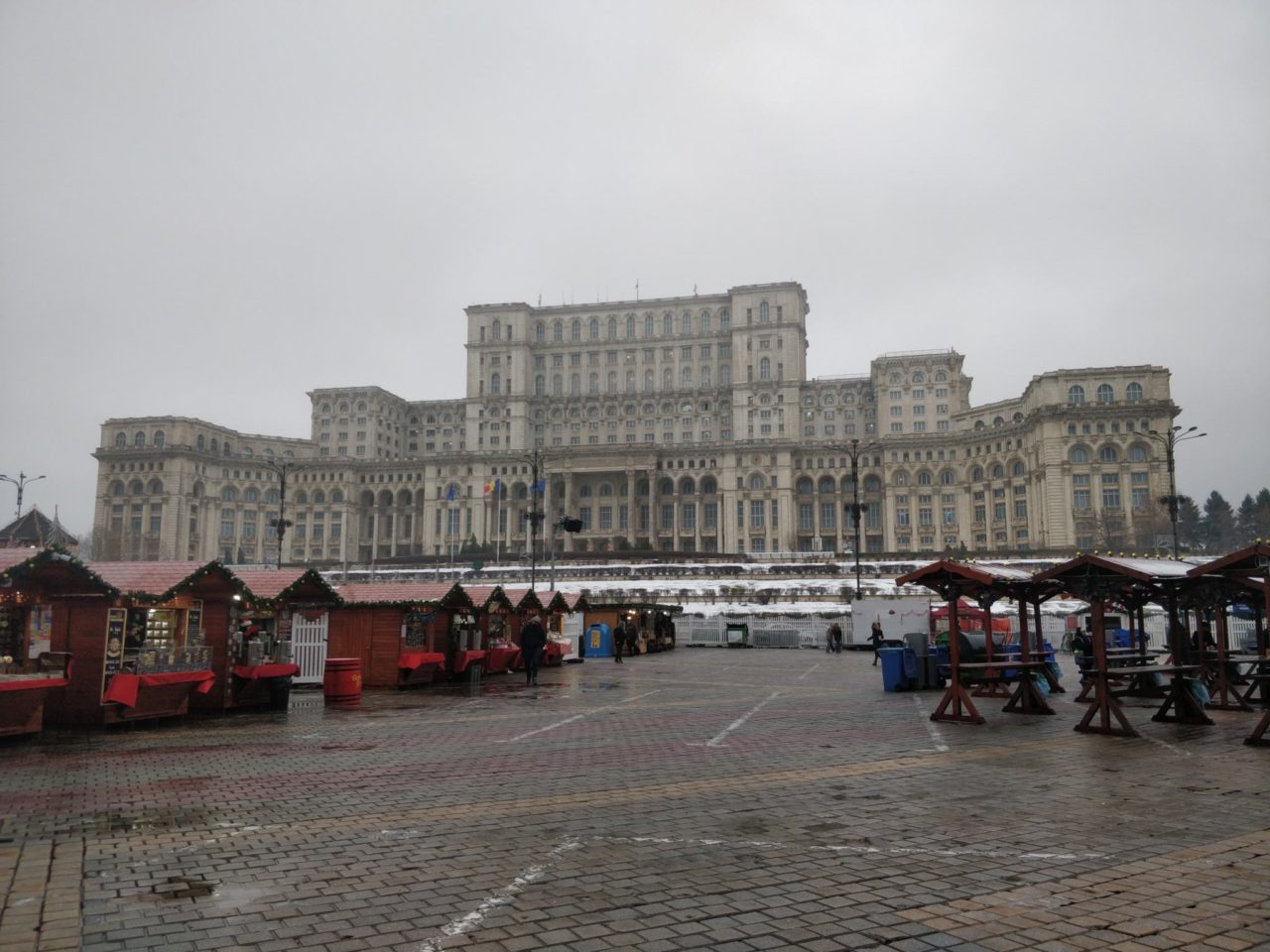

My sister and I have a tradition of going somewhere for a long weekend in December in order to soak in the festive spirit at Christmas Markets across Europe and last year we decided to visit Bucharest, Romania’s capital city.
We made the decision to visit Bucharest based on a recommendation from my husband who had heard that the city’s Christmas Market was up and coming and well worth a visit. Of course, a major bonus was that Vlad, my husband, is from Moldova (a neighbour of Romania) and can speak Romanian!
Of course many people visit this city at other times of the year, for example it is very popular for Stag Dos. If you’re planning a Stag Do in Bucharest this guide is a must read.
Although we did visit the Christmas Market several times during our long weekend trip we also wanted to see some of the local sights and learn more about the history of Romania, so today I am going to tell you about 6 of the things we did on our long weekend in Bucharest.
Palace of the Parliament
The Palace of the Parliament (Palatul Parlamentului) is the seat of the Parliament of Romania. This colossal building was designed and supervised by chief architect Anca Petrescu and it took a team of 700 architects 13 years to construct.
The building’s ornate interior is made up of 23 sections and houses the two houses of the Parliament of Romania: the Senate (Senat) and the Chamber of Deputies (Camera Deputatilor). There are also three museums and an international conference centre.
The building is known for its totalitarian kitsch style of architecture, in Totalitarian and modernist Neoclassical architectural forms and styles which you can really appreciate when you take a guided tour which I heartily recommend.
Ceauşescu Mansion
Nicolae Ceauşescu was the last Communist leader of Romania. For 25 years he lived at the Spring Palace (Primaverii Palace), also known as the Ceauşescu Mansion, along with his wife Elena Ceauşescu and of their children, Nicu, Zoia, and Valentin.
The Palace was designed in the mid-1960s to the exact specifications of the former dictator and his wife, who reportedly personally picked the chandeliers and mosaics for the 80-room residence which includes wildly decorated living quarters complete with Renaissance and Rococo decorations, a cinema, a swimming pool, extraordinary dressing rooms and an eye-catching gold-plated bathroom.
When the Ceauşescu family inhabited the house ordinary Romanians were living on strict food and fuel rations, a raw counterpoint to the opulent life of the communist leader and his family. I recommend taking a tour as we learnt much about the house, people and times from our guide.
Old Town
You often find many hidden gems in the Old Town of any city and Bucharest Old Town is no different. This is the area where it is said Bucharest was founded but sadly for many decades, the Old Town had been neglected.
However, recent infrastructure renovation works have seen new life breathed into the area with many period buildings being refurbished or restored. Despite the upgrade, the Old Town still showcases amazing historic architecture with old churches, the outdoor terraces and cafés appealing to anyone who wants to escape the bustle of the city.
The Old Town is now a trendy entertainment and dining venues making it a popular hangout for locals. I loved discovering the covered cafe pedestrian street and I was particularly thankful for the restaurants in the Old Town which serve vegan food!

The Church of the Stavropoleos Monastery
When you walk around Bucharest you can’t help but notice all of the beautiful Churches and religious buildings which are highly photogenic. My favourite of these is the Church of the Stavropoleos Monastery which was only a short walk away from where we stayed.
Built-in 1724 sadly the majority of the Stavropoleos Monastery has been destroyed due to earthquakes and demolition, save for the dainty and beautiful Church which today is an Eastern Orthodox Church cared for by nuns.
The Church whose patrons are St. Archangels Michael and Gabriel, is built in Brâncovenesc style, developed in the late 17th and early 18th centuries, an extraordinary mix of Byzantine, Ottoman, late Renaissance, and Baroque architecture. The interior of the Church is covered with amazing iconographic murals which are well worth a look.
The Kitsch Museum
If you have some spare time and are open minded why not consider a trip to The Kitsch Museum; a celebration of all things in poor taste from the local culture.
The Romanian Kitsch Museum showcases a collection of around 200 of the country’s most garish, creative, ridiculous and somewhat distasteful objects housed on 2 levels, broken up into eight different categories including Communist kitsch, Dracula kitsch, Gypsy and Religious kitsch.
Although we were truly baffled by the amount of garish and bizarre items on display there were some eye-opening features which gave us an insight into the Romanian culture so if you’re open minded why not drop in? See more information on their website.


National Museum of Romanian History
Something we always try to do when we visit a new country is to learn something about its history and culture and on our visit to Bucharest we spent a couple of hours browsing in the National Museum of Romanian History which is one of the representative institutions of the Romanian culture and contains Romanian historical artefacts from prehistoric times up to modern times.
The Museum houses over 650,000 pieces arranged in a number of collections across 60 valuable exhibition rooms including pottery, lapidarium (an extraordinary life-size copy of the base of Trajan’s Column), numismatics, philately, medals-seals, jewels, manuscripts, printed works, plastic arts, decorative art, historical photographs, engravings, maps, metal, weapons and equipment, textiles and furniture.
My favourite collection was that of the 3,000+ wonderful pieces displayed in the Historical Treasure displays which are made of precious metals and stones from across Romania’s history including the Romanian Crown Jewels and the Pietroasele treasure: the 12 surviving pieces of the 22 gold objects discovered in Romania which are among the most famous examples of the polychrome style of Migration Period art.
Have you been to Bucharest? What was your favourite thing to do?